Hoi An Ancient Town– an ancient city located on the banks of the romantic Thu Bon River, has long become an attractive destination for domestic and foreign tourists. This place attracts tourists because of its simple, rustic beauty and unique cultural and historical values. This article will share with you the complete Hoi An travel experience from A to Z, helping you have a perfect and memorable trip to “healing” your soul.
Ideal Time to Travel to Hoi An
- The best time to visit Hoi An is from February to July, when the weather is cool and dry.
- In August and September it starts to rain in the evening.
- Avoid the rainy season from October to December to avoid rainstorms that hinder your journey.

Figure 1. Dry weather in Hoi An from February to July
How to Travel to Hoi An
- Plane: Da Nang International Airport is the closest airport to Hoi An, about 30km away.
- Train: Da Nang Station is the closest train station to Hoi An.
- Passenger car: There are many reputable bus companies operating routes to Hoi An from other provinces and cities across the country.

Figure 2. Means of transportation to Hoi An
Means of Transportation in Hoi An
In Hoi An, you can travel by bicycle, motorbike, cyclo or on foot. Bicycles are a popular means of transportation for many tourists because of the compact city space and many routes dedicated to cyclists.
Accommodation in Hoi An
Hoi An has many accommodation options from luxury hotels to cozy homestays. You should book early, especially during peak tourist season.
Some famous hotels you can refer to:
- SENVILA Boutique Resort & Spa – 4-star hotel, price: 728,362 VND/night.
- Bay Resort Hoi An – 5-star hotel, price: 3,295,928 VND/night.
- Almanity Hoi An Resort & Spa – 5-star hotel, price: 2,099,548 VND/night.
- KOI Resort and Spa Hoi An – 4-star hotel, price: 1,542,192 VND/night.
- Victoria Hoi An Beach Resort and Spa – 4-star hotel, price: 1,870,000 VND/night.
- Vinpearl Resort & Golf Nam Hoi An
Some famous homestays in Hoi An:
- La Siesta Hoi An Beach Homestay
- Hoi An Eco Home
- The Hoi An Balcony
- Hoi An Coco Homestay
Note: Our latest room rental prices are updated (July 2024) according to the prices on each unit’s website. Visitors should contact the units directly to get the most accurate advice and quotes.
Schedule
- 2 days 1 night itinerary: Suitable for tourists with little time, focusing on visiting Hoi An ancient town and some other famous places.
- 3 days 2 nights itinerary: Allows you to explore Hoi An in more detail, combining visits to traditional craft villages and Cu Lao Cham island.
- 4 days 3 nights itinerary: A perfect itinerary for you to visit Hoi An ancient town and neighboring Hoi An tourist destinations such as Da Nang or My Son Tower.
You can refer to our Hoi An travel itinerary and combine them to suit your personal time and schedule:
- Complete Da Nang – Hoi An Travel Experience in Only 4 Days and 3 Nights (4D3N)
- Da Nang – Hoi An Travel 3 Days 2 Nights: Recharge Your Soul & Enjoy Life
- Explore Da Nang – Hoi An Travel 2 Days 1 Night: Perfect Weekend Itinerary At The Meeting Place Between The Sea & The Old Town
- Hue – Da Nang – Hoi An: Journey to Explore the “Golden Triangle” Vietnam Tourism
What to eat in Hoi An?
When coming to Hoi An, you cannot miss these Unique Hoi An specialties such as cao lau, chicken rice, wontons, spring rolls, grilled meat vermicelli, banh xeo… or snacks like Tofu, sweet soup, banh can, street cakes,… Each dish has a distinct flavor and shows sophistication local food.

Figure 3. Hoi An cuisine with many delicious specialties
You can consult Latest Delicious Places to Eat in Hoi An 2024:
- Anabas Restaurant – Famous Hoi An specialty restaurant serving a variety of delicious local dishes
- Phuong Bread – Famous Hoi An Bread
- Madam Khanh Bread – “Queen of bread” in Hoi An
- Ba Buoi Chicken Rice – A famous delicious food place in Hoi An for nearly 70 years
- Gieng Ba Le Restaurant – Delicious, crispy pancakes
- Ong Hai Quang Noodles – Quang noodles rich in local flavor
- Cao Lau Thanh – Delicious place to eat traditional Cao Lau in Hoi An
- White Rose Restaurant – Hoi An’s famous cauldron dumpling oven
- Stir-fried mussel cake at Ni Ba Gia restaurant
- Banh Beo Ba Bay – Place to eat delicious banh beo in Hoi An
- Anh Dung wonton – Famous wonton restaurant in Hoi An
- Mot Hoi An – Famous gleaning shop in Hoi An
In addition, there are many snack shops all over the small streets in the ancient town of Hoi An, you can easily see street vendors selling attractive street food. Let’s conquer the Hoi An snack “map”: Delicious – Nutritious – Cheap and “Discovering” 10+ Famous Milk Tea Shops In Hoi An That Are Super Quality For All Tastes.
Hoi An Ancient Town is a UNESCO world cultural heritage site, located in Quang Nam province, Vietnam. This place is famous for its ancient houses, narrow streets and sparkling lanterns. Hoi An Ancient Town is an ideal destination for “healing” for you 10+ “Top of the Peak” Experiences through the tourist destinations we suggest below.
Suggested tourist attractions in Hoi An ancient town
Covered Bridge – Symbol of Hoi An Ancient Town
Covered Bridge is a symbol of Hoi An ancient town. The pagoda was built in the 16th century and is a unique combination of Japanese and Vietnamese architecture. Covered Bridge is a great place to enjoy views of the Hoai River and the old town. Inside the pagoda worships Bac De Tran Vo, the god who protects the land and brings good things to the people. An interesting thing that foreign tourists may not know is that the Covered Bridge is an image printed on a polymer banknote with a face value of 20,000 VND.

Figure 4. Covered Bridge and 20,000 VND banknote
Good news for tourists, Hoi An Covered Bridge has completed restoration after more than a year and a half and it is expected that visitors will be able to visit with a more solid appearance but still retain the architectural features that have existed for 400 years. of Cau Pagoda. The restoration work contributes to preserving and embellishing the unique cultural heritage value of the Covered Bridge and is an important milestone in the work of preserving cultural heritage in Hoi An.
Ancient houses in Hoi An
- Tan Ky Ancient House – Address: 101 Nguyen Thai Hoc, Minh An Ward, Hoi An, Quang Nam. Tan Ky ancient house was built in 1750 by a wealthy Chinese merchant. The house is a classic example of traditional Hoi An townhouse architecture, with a long, narrow facade and internal courtyard. The house is beautifully decorated with intricately carved wooden details and antique furniture. Tan Ky ancient house is currently a place to preserve historical and cultural artifacts of Hoi An.
- Phung Hung Ancient House – Address: 4 Nguyen Thi Minh Khai, Minh An Ward, Hoi An, Quang Nam. Phung Hung ancient house was built in the early 19th century by a Chinese merchant. The project is made entirely of high-quality wood, creating luxury and overall harmony with the ancient beauty of the heritage region.
- Diep Dong Nguyen Ancient House – Address: 80 Nguyen Thai Hoc, Minh An Ward, Hoi An, Quang Nam. This is a typical example of Hoi An’s interference architectural style. This project has been the home of five generations of the Diep family, and was built in the late 19th century for Chinese businessman Diep Ngo Xuan, a traditional medicine practitioner from Guangdong.
- Quan Thang Ancient House – Address: 77 Tran Phu, Minh An Ward, Hoi An, Quang Nam.
- Thai Phien Ancient House – Address: 104 Thai Phien, Minh An Ward, Hoi An, Quang Nam.
Assembly halls in Hoi An
- Quang Dong Assembly Hall – Address: 176 Tran Phu, Minh An Ward, Hoi An, Quang Nam. The Cantonese Assembly Hall was built in 1675 by the Cantonese Chinese community who came to Hoi An to live and trade. This is the largest and most famous Assembly Hall in Hoi An, with unique architecture combining Chinese and Vietnamese elements. The Assembly Hall worships the gods Quan Cong, Guangdong Tien Hien and Thien Hau.
- Chaozhou Assembly Hall – Address: 362 Nguyen Duy Hieu, Cam Chau, Hoi An, Quang Nam. The Assembly Hall was built around the mid-19th century, where the Chinese community worshiped General Ma Vien. This is a famous general of the Han Dynasty who was worshiped as a god protecting seafarers.
- Phuoc Kien Assembly Hall (Fujian) – Address: 46 Tran Phu, Cam Chau, Hoi An, Quang Nam. Fujian Assembly Hall was built in the 17th century by the Fujian Chinese community who came to Hoi An to live and trade. This place worships Thien Hau Thanh Mau and is a place for merchants to come and pray for a smooth and prosperous trip.
- Hai Nam Assembly Hall – Address: 10 Tran Phu, Cam Chau, Hoi An, Quang Nam. This clubhouse was built in 1851, and has an area commemorating the 108 Chinese traders who were killed at sea.
Famous pagodas in Hoi An
In addition to the Covered Bridge, a symbol of Hoi An ancient town, in Hoi An there are many old pagodas with unique and pure architecture that tourists can visit to pray for peace:
- Ba Mu Pagoda – Address: 675 Hai Ba Trung, Old Town, Hoi An, Quang Nam. This place attracts tourists because of its unique architecture, long historical value and pure, sacred atmosphere. The pagoda was built in the early 17th century, worshiping Lady Lieu Hanh – a deity trusted and worshiped by local people. Through many historical ups and downs, the pagoda has been restored many times but still retains its original architectural and cultural values.
- Phap Bao Pagoda – Address: V8HG+CPQ, D. Phan Chu Trinh, Minh An Ward, Hoi An, Quang Nam.
- Vien Giac Pagoda – Address: 48 Hung Vuong, Cam Pho Ward, Hoi An, Quang Nam.
- Chuc Thanh Pagoda – Address: Area 7, Tan An Ward, Hoi An City, Quang Nam Province, Tan An, Hoi An, Quang Nam.
Hoi An Market
Located in the heart of Hoi An ancient town, Hoi An Market has long become a destination not to be missed for tourists when arriving in this heritage land. Rich in cultural imprints, bustling life and especially rich cuisine, Hoi An Market attracts visitors with its unique blend of traditional and modern beauty.
The market is divided into separate areas, visitors can both enjoy Hoi An cuisine and shop for souvenirs:
- Area Hoi An cuisine: Culinary paradise with specialties and other regional dishes.
- Souvenir area: Where visitors can find and buy unique souvenirs, bearing the mark of Hoi An.
- Fresh seafood area: Providing fresh seafood, just caught from the sea.
- Fruit and vegetable selling area: Brings fresh food to locals and tourists.
Coming to Hoi An, you can visit the Museums Worth Visiting in Hoi An to better understand the history of formation and development of Hoi An ancient town, from a busy trading port of previous centuries to into a world cultural heritage recognized by UNESCO.

Figure 5. Hoi An Market
Suggested tourist attractions near Hoi An
Traditional craft villages in Hoi An
- Tra Que Vegetable Village – Address: Cam Ha, Hoi An, Quang Nam. This place is famous for its herbs and specialty vegetables, used in many traditional Vietnamese dishes. Visitors can tour vegetable fields, learn how vegetables are grown and harvested, and shop for fresh produce at the local market.
- Kim Bong Carpentry Village – Address: V88F+4Q2, Cam Kim, Hoi An, Quang Nam. This place is famous for its handicraft wooden products, made from precious woods such as ebony, mahogany, and rosewood. Visitors can tour carpentry workshops, watch artisans at work, and shop for unique products such as furniture, statues, and decorations.
- Thanh Ha Pottery Village – Address: group 24, Nam Dieu block, Quang Nam. This place is famous for ceramic products, made by hand using traditional methods. Visitors can tour pottery kilns, watch artisans at work, and shop for unique products such as vases, pots, statues, and decorations.
- Hoi An Silk Village – Address: 28 Nguyen Tat Thanh, Cam Pho Ward, Hoi An, Quang Nam. This place is famous for high-quality silk products, handwoven from natural silk. Visitors can visit silk weaving workshops, watch artisans at work, and shop for unique products such as clothes, scarves, and silk paintings.
- Hoi An Lantern Village: This place is famous for its handmade lantern products, made from bamboo, paper, and silk. Visitors can visit lantern-making workshops, watch artisans at work, and shop for unique products to decorate their homes or give as souvenirs.
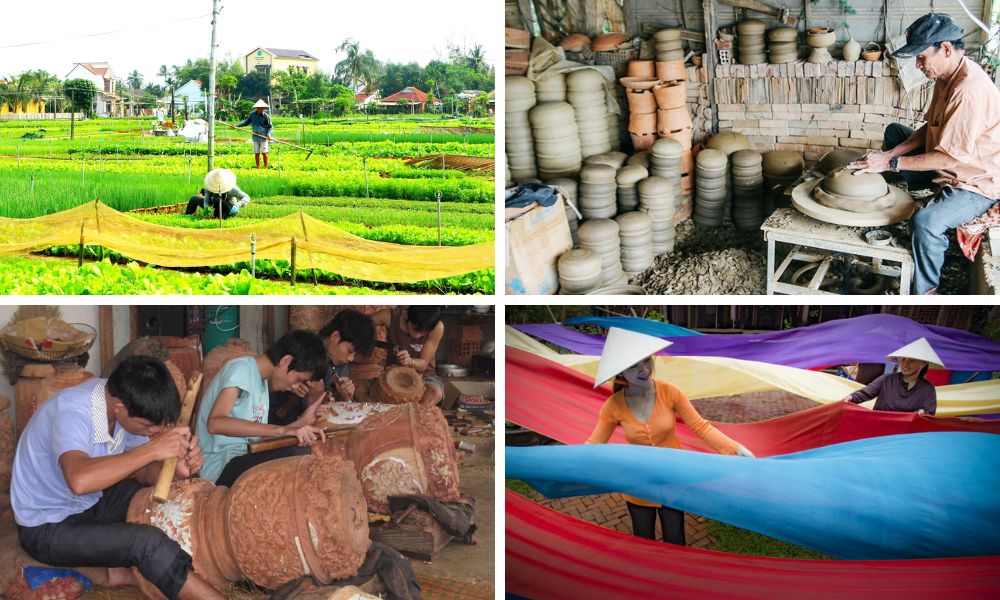
Figure 6. Traditional craft villages in Hoi An
Cu Lao Cham, Hoi An
Cu Lao Cham is an archipelago of 8 islands located in Hoi An city, Quang Nam province, Vietnam. This place is known as the “Green Pearl” of Hoi An and is a world biosphere reserve recognized by UNESCO. Cu Lao Cham is famous for its pristine beaches, fine white sand, clear blue sea water and diverse marine ecosystem.
How to go:
- Visitors can travel to Cu Lao Cham by canoe: Travel time is only about 20 minutes. The canoe is quite clean and beautiful, moves quickly and sometimes you experience the thrill of the sailor steering. However, if you go by canoe you will not be allowed to bring a motorbike and your luggage must be light.
- Reference ticket price:
- Child ticket (round-trip): 225,000 VND/person returning on the same day
- Adult ticket (round-trip): 400,000 VND/person for same-day travel
In addition, traveling by market boat: Except for backpackers, very few people choose to travel by market boat. In addition, it is not easy for everyone to catch a market boat to go to the island. The price for traveling in this form is very reasonable, including motorbikes, only about 100,000 – 150,000 VND/person. When you get to the island, you can freely roam around on the island.
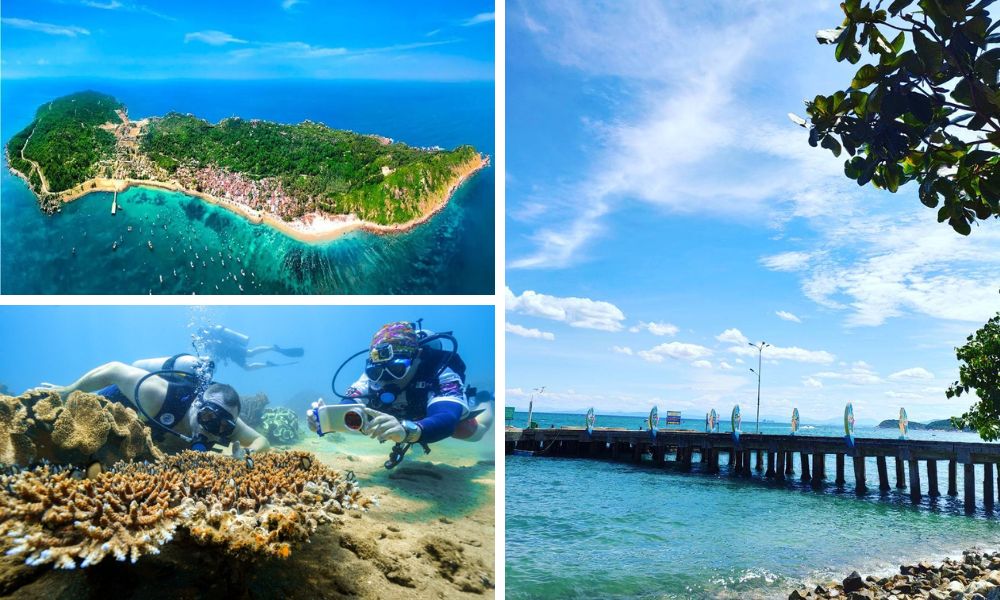
Figure 7. Cu Lao Cham, Hoi An
Places to visit on Cu Lao Cham island:
- Bai Lang Beach: This is the most beautiful beach on Cu Lao Cham with fine white sand, clear blue sea water and romantic coconut trees. Visitors can swim, sunbathe, participate in water sports activities or simply relax on the sand.
- Eo Gio Cu Lao Cham is about 3km from Bai Lang, this place is considered a protective wall for people on the island.
- Cham ancient well: Cham ancient well was built in the 17th-18th centuries, and was the only source of fresh water for the people of Cu Lao Cham in the past. The ancient well has unique architecture with exquisite Champa patterns.
- Hai Tang Pagoda
- Cornflower road
- Tan Hiep Market
- Temple of the ancestors of the bird’s nest industry
Some interesting experiential activities in Cu Lao Cham that visitors can explore include diving to see coral reefs, fishing with fishermen on the island, camping on the island,…
My Son Sanctuary – Unique Champa cultural heritage
My Son Sanctuary, located in Duy Phu commune, Duy Xuyen district, Quang Nam province, is a complex of Champa relics with more than 70 ancient temples and towers, nestled in the middle of a valley surrounded by majestic hills and mountains. This place was an important religious and political center of the Champa kingdom for more than 10 centuries, from the 4th to the 14th century AD.
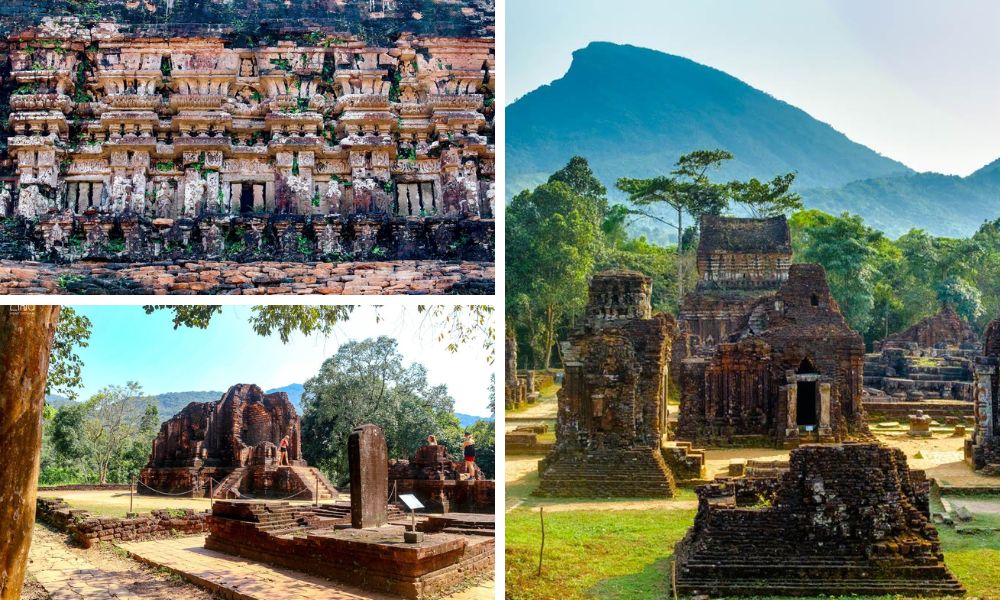
Figure 8. My Son Sanctuary
History of formation: Built around the 4th century under the reign of King Bhadravarman, My Son served as a place to worship Shiva – the supreme god in Hinduism and the Champa kings.
Through many historical ups and downs, My Son was devastated by war and natural disasters, but still retains its unique cultural and architectural values.
Outstanding value:
Architecture: The temples and towers are built of baked bricks, with special construction techniques, stacked on top of each other without using mortar. Each tower represents the sacred peak of Mount Meru – the seat of the gods.
Sculpture: On the tower body and auxiliary structures, visitors can admire sophisticated sculptures depicting gods, religious rituals, and the daily life of the Champa people.
Cultural value: My Son is a testament to the brilliant development of Champa culture, expressed through architecture, sculpture, and religious beliefs.
In 1999, My Son Sanctuary was recognized by UNESCO as a World Cultural Heritage. Today, My Son is a destination that attracts domestic and foreign tourists, a place to learn about the history, culture and unique architecture of the Champa people.
Some useful information:
- How to get there: My Son is about 40km from Hoi An ancient town, visitors can travel by motorbike or car.
- Reference ticket price: 40,000 VND/person (Vietnamese) and 150,000 VND/person (foreigners).
- Opening hours: 7:00 – 17:00 (open all days of the week).

Figure 9. Another corner of My Son Sanctuary
Tips for Taking a Trip Travel to Hoi An 2024 Economically and Completely
- Book air tickets and hotels in advance to receive preferential prices.
- Join group tours to save costs.
- Shop at local markets instead of tourist stores.
- Things to Note When Traveling to Hoi An
- Respect local culture and customs.
- Always maintain hygiene and do not litter.
- Pay attention to preserving personal assets, avoid pickpockets or scams.
- Traffic safety: Be careful when riding a bicycle or motorbike.
- Medical: Bring necessary personal medications, sunscreen and mosquito repellent.
- Learn some basic communication sentences: Makes it easier for you to interact with local people.
- In the morning Hoi An is very special because of the peace and quiet here, mostly only local people preparing for their new day’s activities. Therefore, you should get up early to enjoy this peaceful beauty and take advantage of checking in to Hoi An’s streets when there are not many tourists.
- You can rent a long stay Ao Dai Rental Locations in Hoi An with many designs and reasonable prices to have sparkling photos in Hoi An ancient town. If you order tailored clothes in Hoi An, you should plan for repair time to get the most satisfactory outfit and choose the TOP Famous, Reliable “Standard” Ao Dai Tailoring Shops in Hoi An.
Traveling to Hoi An is a wonderful experience, bringing many memorable memories. Careful preparation and noting important points will help you have a smooth and safe trip. Enjoy and explore the beauty of Hoi An in your own way!

Cập nhật lần cuối: 26/09/2024 09:55


 Vietnam
 Korea
Korea